
Ultimate Guide to Passing CPCU 551
Earning your CPCU® designation can help you advance your insurance career, but you must first complete a number of courses that can be quite challenging. In this post, we’ll go over everything you need to know about the CPCU 551 course and give you tips on how to pass this exam.
What’s in this post
- About CPCU 551
- What is the CPCU program?
- What is CPCU 551?
- How difficult is CPCU 551?
- About the CPCU 551 exam
- Topics covered in CPCU 551
- Topics you are most likely to see on the CPCU 551 exam
- Tips for passing CPCU 551 exam
- Buy our CPCU 551 study guide bundle
CPCU 551 Study Guide e-Bundle – $49.99
What is the CPCU program?
The Chartered Property Casualty Underwriter (CPCU®) is a professional designation offered by an organization called The Institutes. After completing the program, you will have a solid understanding of how the insurance industry works and can display the CPCU designation on your business cards, resume, etc.
Having this designation shows that you have done extra education, which can make you a stronger candidate for hire or promotion. Also, this might give customers, colleagues, and business partners more confidence in working with you because they know you have this foundational knowledge.
What is CPCU 551?
CPCU 551 is one of four concentration courses you may choose from earn your CPCU designation. Whether you are pursuing the traditional CPCU path or the ARM to CPCU path, all students must choose between completing the commercial lines concentration courses or the personal lines concentration courses. CPCU 551 is one of the two commercial lines concentration courses.
This particular course is about the various types of insurance policies available for commercial property damage exposures. The knowledge you gain from this course will help you understand what types of commercial policies are available, how coverage typically applies for each of those policies, and what are the key considerations that producers and customers must think about when deciding on their policy terms and coverage options.
How difficult is CPCU 551?
CPCU 551 involves diving deeply in the policy contract terms that apply for various types of commercial policies. Especially for students who have no experience with commercial policy language, CPCU 551 can be one of most challenging courses for several reasons:
- There are many, many little details to remember and numerous exceptions to the general rules
- There are many endorsements that can used to negate a policy’s standard terms, so you have to remember that the rules are under the standard policy terms and then how the rules are changed if an endorsement is present
- There are several types of multi-step calculations you may need to complete
- Many of the exam questions are situational, where you need to be familiar with all the policy types and endorsements to know which one would be best for the scenario at hand
- Many similar clauses or policy types that are mostly similar but have small differences, and you need to be able to differentiate based on those small differences
If you are using The Institutes’ online course for CPCU 551, there are some aspects that make it difficult to easily review everything again to refresh your memory before test time:
- The sheer amount of detail (which is written mostly in prose and lacking in cheat sheets)
- Many of the explanations on how to do calculations are in video form, so you need to rewatch, pause, rewind to re-review the steps
- The order that the material is organized is not always intuitive/ideal
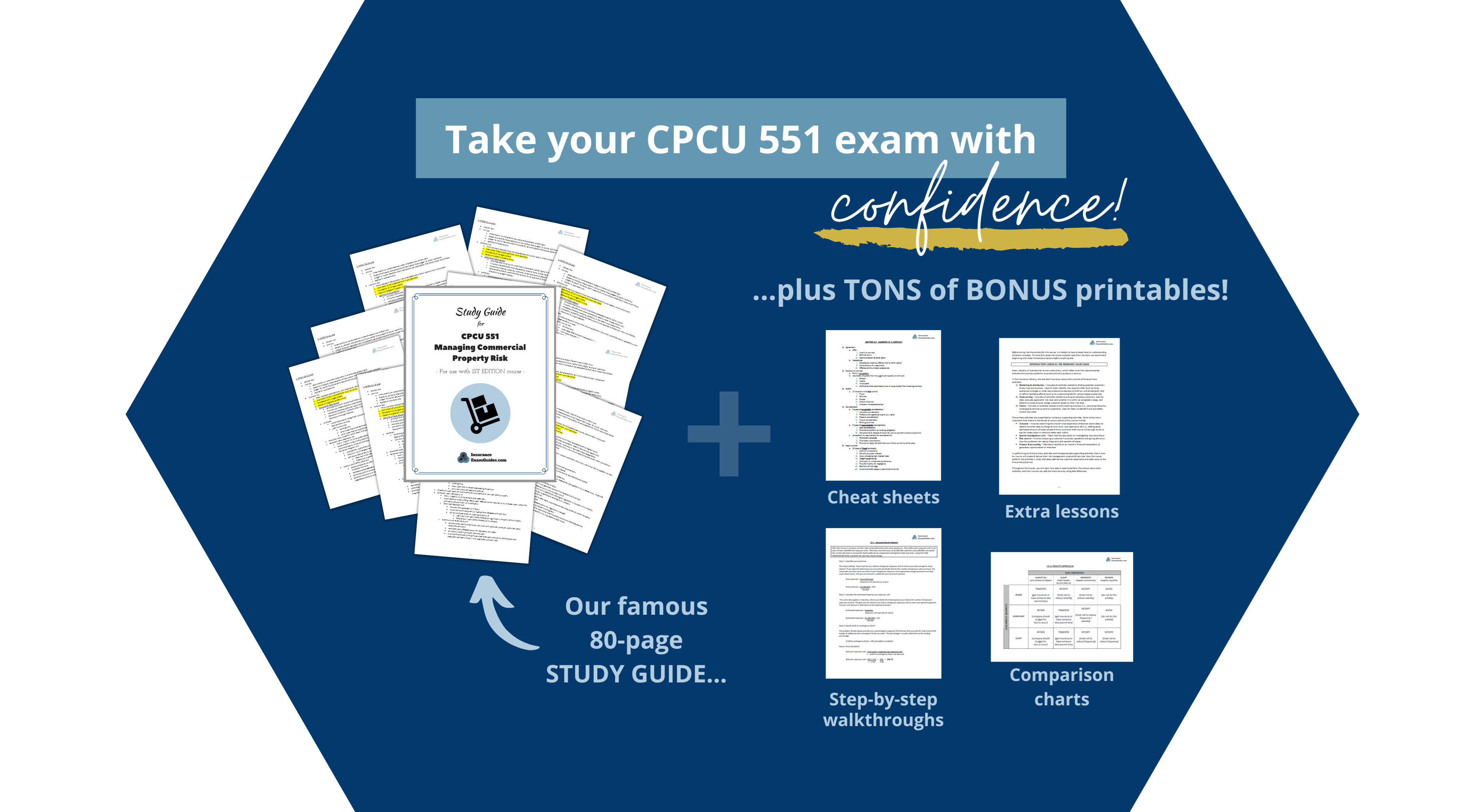
Our study guide bundle and bonus printables are the perfect supplement to The Institutes’ course, and provides tons of tools to help you effectively review everything you need to know:
- Cheat sheets
- Written step-by-step walkthroughs on how to do the various calculations
- Extra lessons to give you helpful background knowledge that will improve your understanding of the materials
About the CPCU 551 exam
In order to demonstrate that you have understood the material from this course, you will need to pass an online exam administered by The Institutes.
You must go through The Institutes' website to purchase and formally register for your exam. When registering, you must indicate which test window you plan to take the exam during. The four test windows that are available every year are:
- January 15 to March 15
- April 15 to June 15
- July 15 to September 15
- October 15 to December 15
You may pay for your exam fee at any time, and those who register before the test window opens will usually receive a discount. However, you can only launch the exam and complete it during the test window you chose at the time of purchase. If you need to reschedule your exam, a new fee will apply.
The exam consists of 50 questions that cover all the chapters from the course, with a time limit of 65 minutes. The exam is done online, and you must get a score of 70% or better to pass. You may retake the exam (and pay a new fee) if you do not pass, but please check The Institutes' policies regarding how often and how soon you can retake the exam, as that may change from time to time.
CPCU 551 Study Guide e-Bundle – $49.99
- Based on CPCU 551: Managing Commercial Property Risk [1st edition]
- For buyer's personal use only (non-transferrable and not for resale)
- (NOTE: this will be the only IEG product available for CPCU 551 as we will not be developing a full study program for CPCU 551)
Topics covered in CPCU 551
- Building & Personal Property Coverage Form
- Business income loss coverage
- Equipment breakdown coverage
- Legal Liability Coverage Form
- Standard Property Policy
- Coverage for natural disaster exposures
- Crime coverage
- Businessowners policies
- Inland marine insurance
How IEG can help: We have a comprehensive study guide bundle that covers every chapter from CPCU 551. We use plain language and helpful examples to help you truly understand the content.
Topics you are most likely to see on the CPCU 551 exam
The following list is based on student feedback regard what topics they felt were most heavily-featured on their exam.
Please remember that this is not a comprehensive list of all the topics that will be tested, and each person’s exam may different. Any of the material covered in the course may potentially appear on your exam, so you should prepare accordingly.
- Building & Personal Property (BPP) – covered perils in basic, broad, and special forms; additional coverages & coverage extensions; specific vs blanket policy limits
- Business Income Coverage (BIC) – definition of business income loss, extra expenses, five additional coverages, how to calculate business income loss amount
- Endorsements – Peak Season endorsement, Value Reporting endorsement
- Equipment breakdown coverage – covered perils, covered types of equipment, valuation methods
- Crime coverage – what each type of insuring agreement would cover
- Businessowners policy (BOP) – differences between BOP vs commercial property part
- Transit-related policies – which types of polices are best suited for certain types of transit needs
- Builders risk policies – when it is used
- Risk financing – comparison of retenton vs transfer, insurable interest
How IEG can help: Our comprehensive study guide includes the key details for all of these topics. We also provide cheat sheets and comparison charts as part of our bonus materials, to help you nail down the finer details that matter.
CPCU 551 Study Guide e-Bundle – $49.99
Tips for passing CPCU 551
1) Pay attention to the details
Many of the question types you will encounter on the exam require you to know a lot of the minute details in order to be able to choose the best answer:
- Knowing which policy is best suited for covering a certain type of exposure
- Knowing which endorsement is best for achieving a particular goal
- Knowing the difference between two items
- Knowing if coverage will apply to a certain scenario
Don’t skip out on learning about the exceptions to coverage, additional terms that apply, extra limitations that apply, etc.
How IEG can help: We include all the key details you’ll need to know in our comprehensive study guide, with everything organized in a very visually intuitive way.
2) Take the time to master the various calculations
We can guarantee that you will encounter several calculation-based questions on your exam. They can include:
- How much would paid out on a property damage claim
- The amount of business income loss
- Coinsurance penalties
These types of calculations aren’t particularly hard, but do involve a few key steps. The best strategy is to do as many practice problems as you can: redo all the practice quiz questions again and again, and even the sample problems from your main course materials.
The nice thing about calculation-based problems are that the right answer is very black and white (unambiguous), so you will immediately know that you probably got the answer right if the result you got is one of the possible answer choices.
How IEG can help: Our study guide bundle includes step-by-step walkthroughs that show you how to do each of different types of multi-step calculations that might appear on your exam.
CPCU 551 Study Guide e-Bundle – $49.99
- Based on CPCU 551: Managing Commercial Property Risk [1st edition]
- For buyer's personal use only (non-transferrable and not for resale)
- (NOTE: this will be the only IEG product available for CPCU 551 as we will not be developing a full study program for CPCU 551)
3) Plan to have an uninterrupted study schedule and avoid extended (multi-day) breaks
CPCU 551 has a particularly extensive amount of little details and rules exceptions. It is very easy to forget these small details if you take extended (multi-day) breaks from studying, so we recommend that you work on the course everyday until you take and pass your exam (rather than breaking it up with vacations or other long breaks in between).
4) Look up actual policy forms to see how different clauses are specifically worded
The Institutes’ paraphrases most of the standard policy terms and sections, but it can sometimes be more helpful to see how things are worded in the actual policy form itself. Most commercial policies are based on standard starting templates that nearly all insurers use, and it is pretty easy to find samples online. Just search for the policy type as a PDF (ex: “builders risk policy pdf”) and take a look at real language used.
5) Don’t waste too much time on long questions or questions that you are stuck on
Every test question is worth only one point, no matter how simple or complex it is. If you find that you are spending a lot of time on one particular problem, you are better off guessing for now and using the option to flag the question so you can return to it later. You don’t want to spend so much time that you run out of time before you can get to all the other questions that might have been easier for you to score points on.
6) Put an answer for every question
You do not get minus points for getting a question wrong, so don’t leave any questions blank.
CPCU 551 Study Guide e-Bundle – $49.99
7) Get as much practice as possible
The best way to ensure that you know how to apply the concepts you are learning is to practice doing that, and practice quizzes are the perfect way to test your understanding. The Institutes’ course does include practice questions, which you should keep reattempting until you are confident you understand the concepts that you are being quizzed on.
The Institutes used to have a Smart QuizMe app that also provided practice questions, but they have since removed the question banks for all the current CPCU & AINS courses from the app. At this time, we do not think that The Institutes will be updating their app to include CPCU & AINS question banks since they have not announced any specific plans to do so.
How IEG can help: The step-by-step walkthroughs we provide with our study guide bundle include sample problems you can work through, with the detailed explanation right there that you can use to immediately check your answer and approach.
8) Aim to understand the practice questions and not just memorize them
The questions on the actual exam are not made up of the practice questions, so you cannot just rely on memorizing those answers for any practice quizzes and simulated exams you take. Read each explanation and re-review the material until you understand why you got a question wrong.
9) Don’t rely solely on The Institutes’ study materials
The Institutes’ way of explaining things is not necessarily the best way, so take advantage of other resources available to you. Some students don’t use The Institutes’ study materials at all and prefer to go with another study option, such as our comprehensive study materials. We use plain English to explain all of the concepts, include helpful examples so you can see how they apply in real life, and show you how different elements of something relate to one another.
You can also turn to Google and YouTube to look for explanations and examples from other sources too.
10) Join the CPCU Candidates Facebook group
One of the best things you can do during your CPCU journey is to join the CPCU Candidates Facebook group, which is a wonderful community of current and former CPCU students. Here, you can get help with test questions that might be stumping you, ask for advice on propelling your insurance career, and find a healthy dose of moral support and motivation.
CPCU 551 Study Guide e-Bundle – $49.99
Why Our Study Guides Work
Learning the material is just the first step. You need a way to refresh yourself on the content because there is so much to remember.
We created our signature study guides to help you quickly and easily review everything you've learned:
Focus on the right things
We condense every chapter to a few pages each, so you can focus on what you need to know.
Understand the key concepts
We provide extra examples & bonus materials to help you understand the trickier concepts.
See how it all relates
Our outlines are super organized and make it easy to see how the concepts relate to each other.

About your instructor
Insurance Exam Guides (IEG) was founded by Stacy Trinh, CPCU®, who first started her teaching journey at the request of her co-workers who were preparing for their CPCU exams. Because of her reputation as an adept trainer and motivator, Stacy's co-workers had asked her to lead a class. The feedback on her sessions and study materials was overwhelming positive, and her students encouraged her to share what she had to offer with the rest of the CPCU community.
Since then, Stacy created a library of study materials for both CPCU® and AINS® that have helped thousands of students pass their exams. As an accounting major and former claims adjuster, her style of instruction incorporates both a financial and operational perspective that makes her study materials well-rounded. She looks forward to helping many more students continue to succeed, including you!
Disclaimers: The Institutes, CPCU®, and AINS® are trademarks of the American Institute For Chartered Property Casualty Underwriters, d/b/a The Institutes. InsuranceExamGuides.com is not affiliated or associated with The Institutes in any way, and The Institutes do not endorse, approve, support, or otherwise recognize InsuranceExamGuides.com or its products or services. CPCU® and AINS® are registered trademarks of The Institutes. All rights reserved.